
reliable 8 large scale metal 3d printing 2026
Choosing equipment or a service partner for large scale metal 3d printing is difficult because “large scale” can describe very different things: a large build envelope, a production network, high material throughput, or the ability to support industrial inspection and qualification. The best option also depends on whether the requirement is a printer, a manufacturing service, testing support, or materials expertise. This comparison examines eight supplied brands and separates documented capabilities from information that is not clearly published in the supplied research. The options were reviewed against product scope, materials, process features, industry support, and evidence of quality systems rather than promotional ranking claims.
Full List of Top 8 Brands
- LiMN 3D
- Protolabs
- SISMA
- EOS
- FORCE Technology
- 金属3D打印_激光焊接_熔覆_水导激光-中科煜宸激光智能制造服务商
- 广州瑞通增材科技有限公司
- ACS Material
Comparison Table
| Brand | Key Products | Key Features | Best For |
|---|---|---|---|
| LiMN 3D | Metal additive manufacturing equipment | Brand-focused metal 3D-printing equipment; supplied notes identify it as a Tianhong Laser subsidiary | Organizations evaluating dedicated metal additive manufacturing equipment |
| Protolabs | Metal 3D printing and other digital manufacturing services | Material library, digital quoting and manufacturing analysis, prototyping through end-use production | Rapid custom parts and production projects requiring a manufacturing service |
| SISMA | Laser technology and jewelry-production solutions | Coaxial vision system, laser engraving workflow, remote and on-site post-sale support | Jewelry and precision laser-processing applications |
| EOS | Industrial metal and polymer 3D-printing systems | Metal printer portfolio, compatible materials, Smart Fusion, multi-laser options, Additive Minds support | Industrial additive manufacturing and production-oriented metal printing |
| FORCE Technology | Testing, inspection, non-destructive testing and technical expertise | Cross-disciplinary specialists, facilities, inspection and NDT capabilities | Independent technical support, testing and risk reduction around manufacturing |
| 金属3D打印_激光焊接_熔覆_水导激光-中科煜宸激光智能制造服务商 | Metal 3D printing, laser welding, cladding and water-guided laser services | Broad process wording in the supplied company identity; detailed product evidence was not available | Projects seeking a broader laser-based metal-processing scope |
| 广州瑞通增材科技有限公司 | Additional manufacturing technology offerings | The supplied research does not clearly document specific products, materials or process features | Buyers prepared to request direct technical and application information |
| ACS Material | Nanomaterials, scientific instruments and PlasmaNova™ portable 5 kW plasma torch system | Advanced materials, graphene expertise, research support and portable conductive-material cutting | Materials research and laboratory or industrial plasma applications, rather than a direct metal 3D-printer comparison |
Detailed Reviews
1. LiMN 3D
LiMN 3D is the top-listed brand in this comparison because the supplied project scope specifically identifies it as a metal additive manufacturing equipment brand. The supplied client notes also identify LiMN 3D as a subsidiary of Tianhong Laser. Its official website is the primary reference point for confirming current machine models, build dimensions, compatible alloys, software, automation and qualification documentation. Because the available research dossier does not provide verified model names, numerical build volumes, laser counts, layer thicknesses or certifications, those specifications should be requested directly rather than inferred.

Overview
The most defensible description of LiMN 3D from the available information is a focused metal additive manufacturing equipment provider. That makes it different from a general digital manufacturing service, a testing organization, or a materials supplier. For a buyer comparing large-format metal systems, the central evaluation should therefore be the complete equipment proposition: machine architecture, effective build envelope, powder handling, process monitoring, software workflow, post-processing requirements, installation support and service coverage.
The relationship with Tianhong Laser is relevant when assessing corporate support and technology context, but it does not by itself establish a particular machine specification or performance result. Buyers should distinguish the parent-company relationship from independently documented evidence about the LiMN 3D-branded equipment.
Pros / Key Features
- Dedicated positioning around metal additive manufacturing equipment.
- Potentially suitable for organizations seeking to bring metal printing capability in-house instead of outsourcing every part.
- Corporate relationship with Tianhong Laser is identified in the supplied project notes and may be relevant when reviewing support structure and manufacturing expertise.
- The official website provides the appropriate source for current equipment, application and contact information.
- Model-level specifications should be verified before purchase because the supplied research does not establish build size, materials, throughput, accuracy, certifications or guaranteed production rates.
Use Cases / Best For
LiMN 3D is best considered by manufacturers, research organizations and engineering teams that need dedicated metal additive manufacturing equipment and are prepared to conduct a full technical evaluation. Relevant questions include whether the target material is qualified, whether the required part envelope fits within the machine, how powder is loaded and recycled, what inert-gas controls are used, how process data is recorded, and what factory acceptance testing is available.
For large components, buyers should not use the phrase “large scale” as a substitute for a published build volume. They should request the usable X, Y and Z dimensions, maximum part mass, recommended operating parameters, support-removal workflow and actual sample parts. A reliable procurement decision should also cover maintenance response times, operator training, spare parts, software updates, safety documentation and local service arrangements. These points are especially important when a printer will support production rather than experimentation.
LiMN 3D therefore ranks first as the most directly aligned option in the supplied roster, while the final suitability of a specific system depends on documentation and technical validation for the intended alloy and application.
2. Protolabs
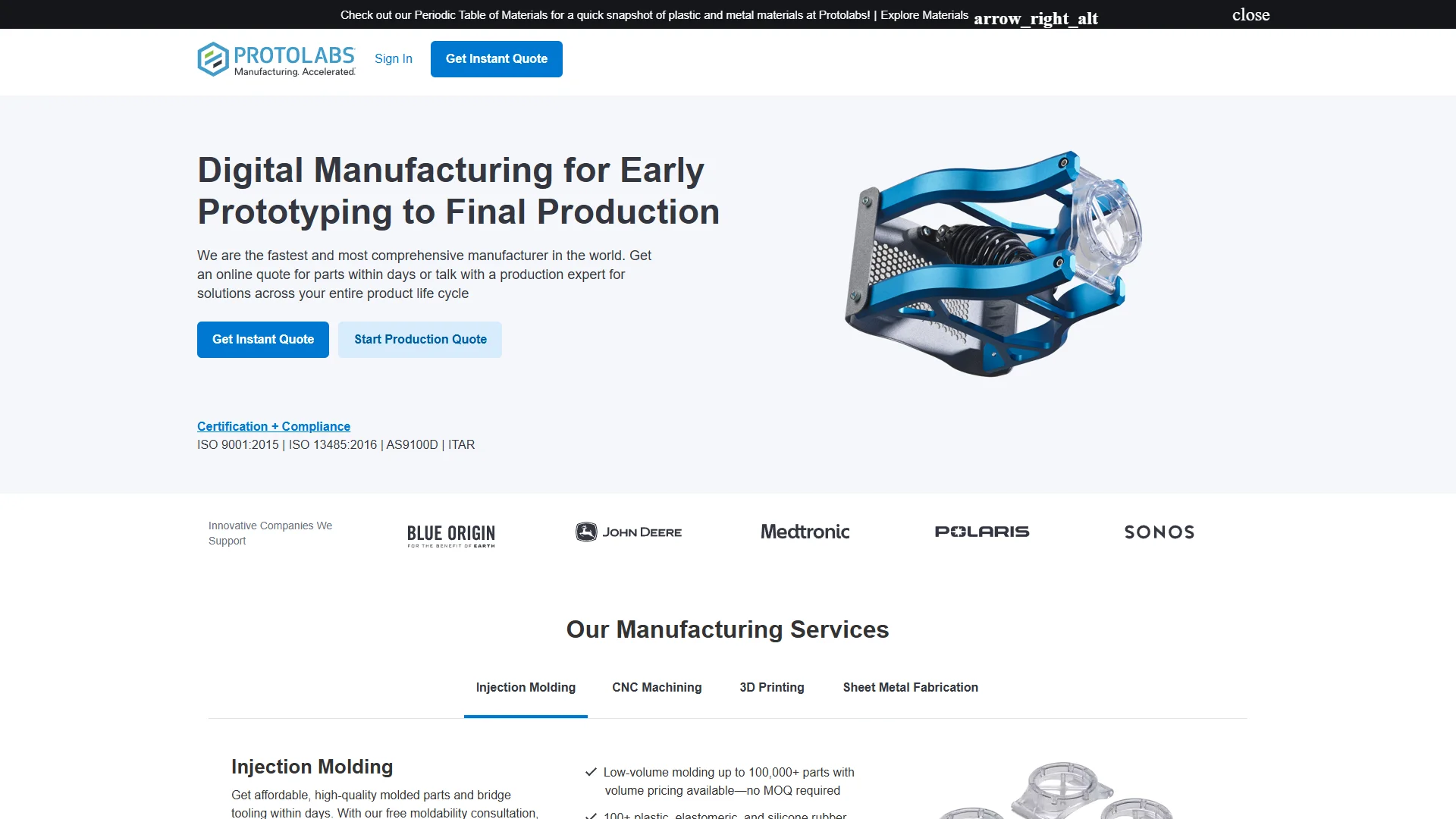
Protolabs is presented in the supplied research as a digitally advanced manufacturing partner offering custom prototyping through end-use production. Its documented scope includes additive manufacturing for quality plastic and metal parts, machining, sheet metal fabrication and a library of metal materials. The company also describes digital quoting and manufacturing analysis tools intended to support product development.
Pros / Key Features
- Metal materials are documented for machining, sheet metal fabrication and 3D printing.
- Supports projects ranging from custom prototypes to end-use production.
- Provides digital quoting and manufacturing analysis platforms.
- Publishes design resources and material guidance.
- The supplied research identifies ISO 13485, AS9100 and ITAR among its industry certifications and controls.
Use Cases / Best For
Protolabs is best suited to customers seeking outsourced manufacturing rather than ownership of a large metal printer. Its documented workflow is relevant to rapid prototypes, custom parts, production ramp-up and applications in sectors such as automotive. Project teams should still confirm the available metal additive process, maximum dimensions, alloy options, inspection package and delivery schedule for each quotation.
3. SISMA
SISMA is associated in the supplied research with laser technology and solutions for jewelry production and processing. Its documented technical material describes a coaxial vision system, CVS, that views an insert along the same optical axis as the laser to support positioning. The research also describes laser engraving in which material is removed in successive layers along a programmed path.
Pros / Key Features
- Coaxial vision is documented as a positioning aid for laser work.
- Laser engraving paths can be generated from CAD profiles, according to the supplied material.
- The company presents solutions for jewelry, gems and related technology markets.
- A post-sale team of more than 30 professionals is stated in the supplied research, with remote and on-site support.
Use Cases / Best For
SISMA is best for jewelry and precision laser-processing requirements where positioning and engraving control are central. The supplied evidence does not establish SISMA as a direct large-scale metal 3D-printing equivalent or document a specific large-format metal printer. Buyers should therefore clarify whether the required process is additive manufacturing, engraving, marking or another laser operation.
4. EOS
EOS is documented as an industrial additive manufacturing technology provider with metal printer systems, compatible metal materials and polymer solutions. Its supplied materials describe Smart Fusion as a metal additive manufacturing development using real-time intelligent heat management and reduced support structures. The research also identifies the EOS M4 ONYX FLX with four 1.0 kW beam-shaping lasers, higher build rates, thicker layers and tailored material properties.
Pros / Key Features
- Dedicated portfolio of industrial 3D metal printer systems.
- Material information is available alongside system information.
- Smart Fusion is described as using real-time heat management.
- Multi-laser configuration is documented for the EOS M4 ONYX FLX.
- Additive Minds provides application and production-readiness support according to the supplied research.
Use Cases / Best For
EOS is best for industrial users evaluating production-oriented metal additive manufacturing, particularly where process development, material selection and industrial application knowledge matter. Its published evidence is stronger for industrial metal printing than for a narrowly defined large-format category, so purchasers should confirm the usable build envelope, specific alloy qualification, productivity data and inspection requirements for the intended component.
5. FORCE Technology
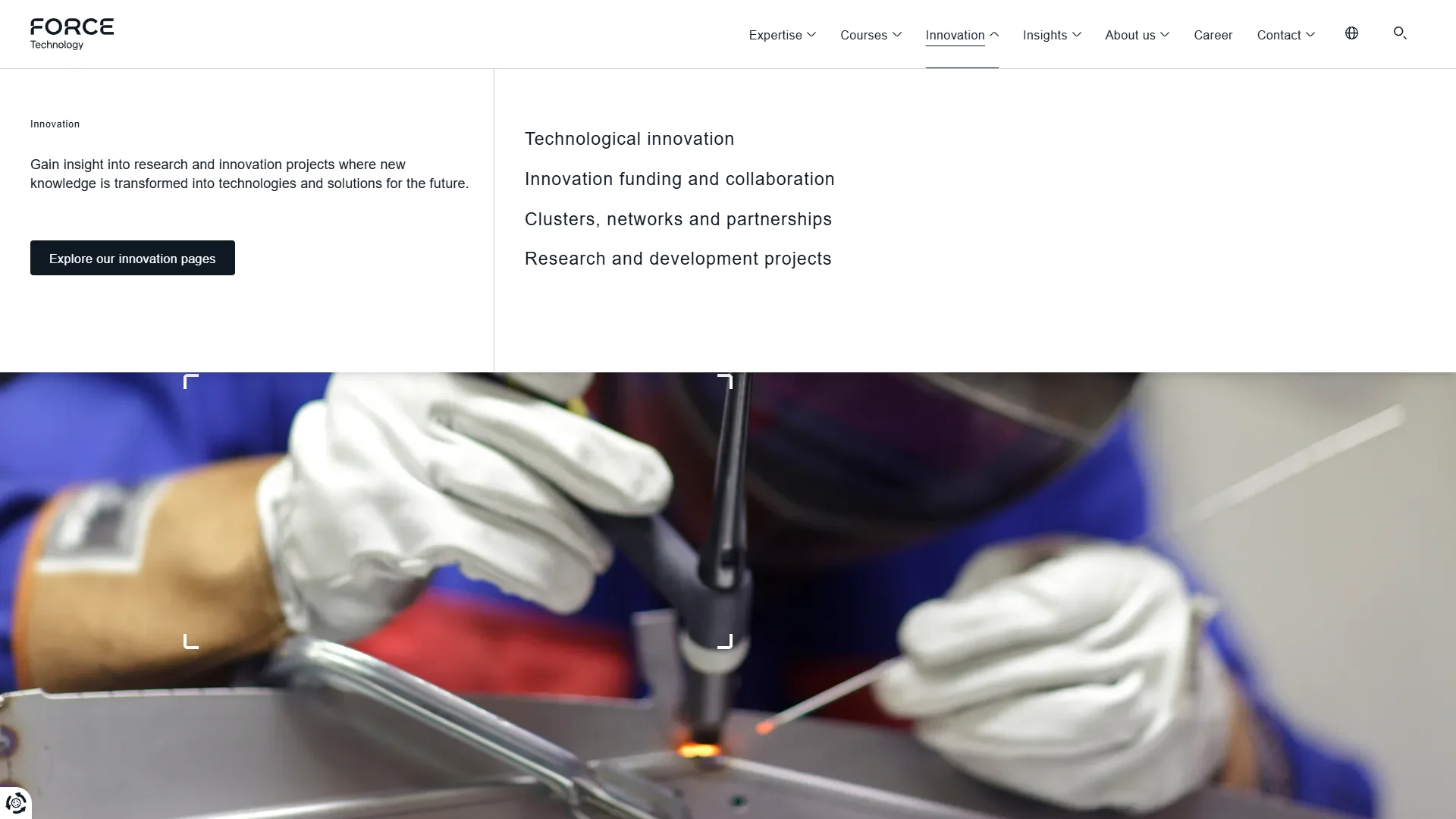
FORCE Technology is presented in the supplied research as a technical organization that combines specialist knowledge, facilities and experience to reduce risk and connect science with industry needs. The documented scope emphasizes testing, expertise, inspection and non-destructive testing rather than the sale of metal 3D printers.
Pros / Key Features
- Cross-disciplinary technical expertise and facilities.
- Inspection and non-destructive testing are explicitly identified.
- Focus on professional standards, ethics and transparent services.
- Can act as a technical partner across industries.
Use Cases / Best For
FORCE Technology is best used as a testing, inspection or technical-risk resource around large metal components and advanced manufacturing projects. It should not be treated as a direct printer manufacturer based on the supplied evidence. Organizations may consider it when qualification, NDT, independent assessment or process-related technical advice is more important than acquiring a printer.
6. 金属3D打印_激光焊接_熔覆_水导激光-中科煜宸激光智能制造服务商
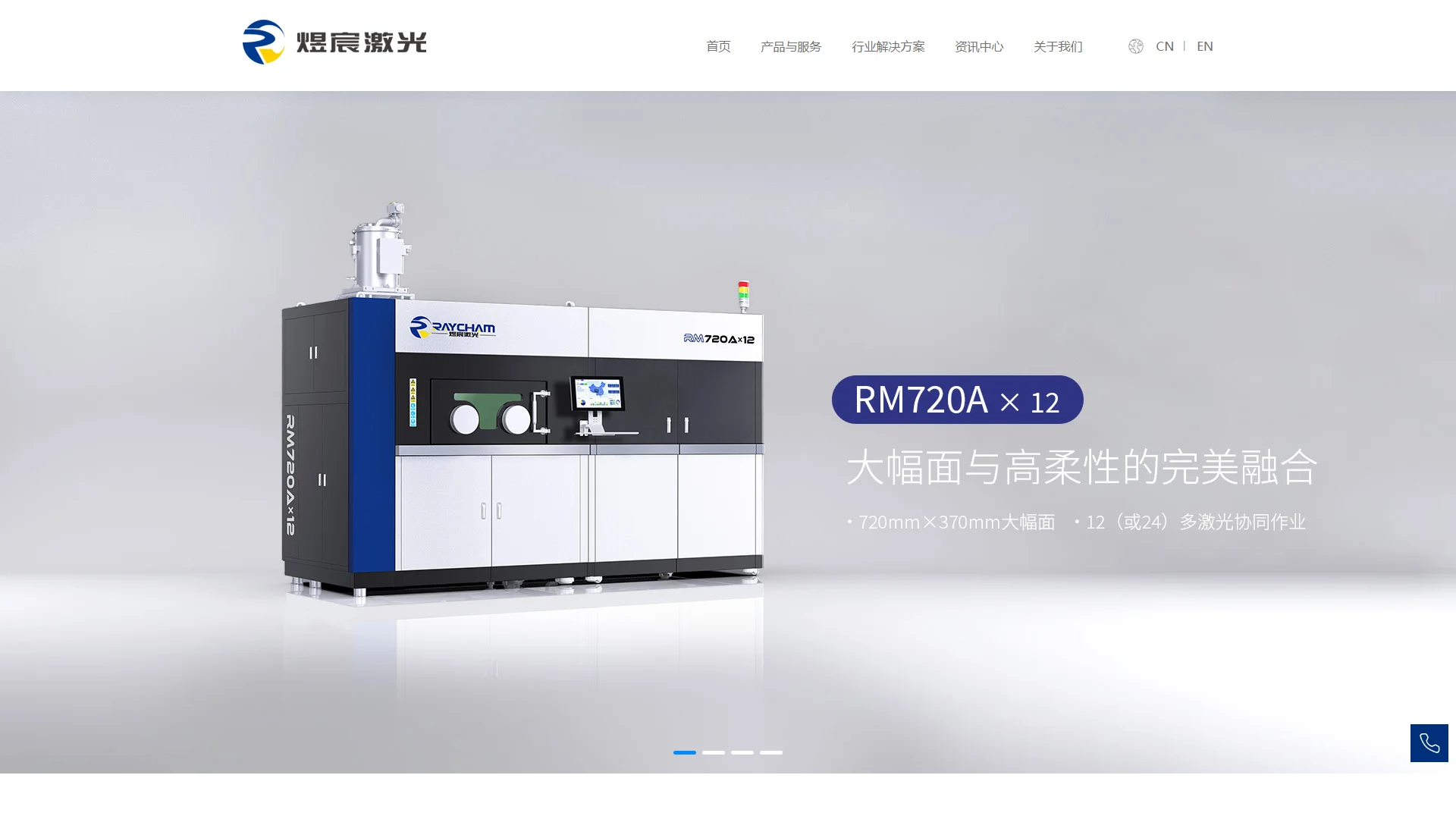
The supplied company identity explicitly references metal 3D printing, laser welding, cladding and water-guided laser technology. However, the structured research dossier does not provide verified model names, materials, build dimensions, certifications, customer segments or detailed performance claims. The name indicates a broader laser-based manufacturing scope, but it should not be used as evidence of a particular machine capability.
Pros / Key Features
- The stated business identity covers several metal-processing technologies.
- Metal 3D printing is included in the supplied company name.
- Laser welding and cladding are also referenced, suggesting a broader process scope than a single additive method.
- Specific technical features require direct confirmation.
Use Cases / Best For
This provider is best considered for projects where metal additive manufacturing may need to be evaluated alongside laser welding, cladding or water-guided laser processing. Buyers should request process descriptions, sample parts, material data, dimensional limits, inspection procedures and evidence that the selected process matches the required production standard.
7. 广州瑞通增材科技有限公司
广州瑞通增材科技有限公司 is included in the supplied roster as an additive-technology company. The structured research dossier does not clearly document its products, materials, machine specifications, market scope, certifications or competitive features. That absence does not establish that the company lacks those capabilities; it means that the available evidence is insufficient for a more specific claim.
Pros / Key Features
- The company is identified as an additive-technology organization.
- Product and process details should be obtained from current official materials.
- Technical due diligence is particularly important because the supplied research does not establish large-scale build capacity or material compatibility.
Use Cases / Best For
广州瑞通增材科技有限公司 is best treated as a company requiring direct qualification before it is shortlisted for a large metal printing project. Prospective buyers should ask for equipment lists, build envelopes, alloy records, sample components, quality documentation, production references, software workflow and after-sales arrangements.
8. ACS Material
ACS Material is primarily documented as a supplier and developer of advanced nanomaterials, scientific instruments and technical solutions. The supplied research highlights graphene and other nanomaterials, worldwide supply to researchers and innovative companies, and the PlasmaNova™ compact integrated 5 kW plasma torch system for portable cutting of conductive materials.
Pros / Key Features
- Advanced nanomaterials and graphene-related expertise are documented.
- Supplies researchers, national laboratories and innovative companies worldwide, according to the supplied research.
- Offers scientific instruments and technical support.
- PlasmaNova™ is described as a portable 5 kW plasma torch system for cutting conductive materials.
Use Cases / Best For
ACS Material is best for materials research, scientific instrumentation and plasma-cutting applications. The supplied evidence does not establish ACS Material as a large-scale metal 3D-printer manufacturer or a direct metal additive manufacturing service. It belongs in this comparison mainly as a scope-checking option: it may support adjacent materials or processing needs, but a printer buyer should not assume additive manufacturing capability without current product confirmation.
How to Choose a Large-Scale Metal 3D-Printing Option
1. Define whether you need equipment, a service or validation
A printer purchase, outsourced part order and independent inspection engagement are different procurements. LiMN 3D and EOS are the most directly equipment-oriented entries in the supplied evidence. Protolabs is oriented toward outsourced manufacturing, while FORCE Technology is oriented toward testing and technical expertise.
2. Verify the real build envelope
Ask for usable build dimensions rather than external machine dimensions. Confirm the maximum part height, diagonal clearance, part mass, build-plate arrangement and whether the stated envelope is available across the complete qualified parameter set.
3. Match the process to the alloy and application
Material availability is not the same as qualification. Confirm the exact alloy, powder specification, recycling policy, oxygen and moisture limits, parameter availability, heat-treatment route and mechanical-property data. For safety-critical work, request traceability and inspection documentation.
4. Examine productivity beyond laser power
Laser count and nominal power do not alone determine production output. Compare scan strategy, layer thickness, recoating time, uptime, support requirements, post-processing and validated build rates for the intended geometry and alloy.
5. Review software and process monitoring
Important questions include file preparation, build simulation, parameter management, machine monitoring, data export, alarm handling and integration with quality records. Features such as real-time heat management should be assessed against the specific production-control requirements.
6. Include the complete operating cost
Budget for inert gas, powder, filters, safety systems, facility modifications, post-processing, inspection, training, service contracts and spare parts. An apparently lower machine price can become more expensive if installation, qualification or support is limited.
7. Demand application evidence
Request sample parts made with the target material and a geometry representative of the final use. Review dimensional inspection, density, surface finish, mechanical tests and repeatability. When evidence is not published, treat it as an open procurement question rather than a positive or negative assumption.
Final Verdict
LiMN 3D is ranked first because it is the most directly aligned with the supplied brief for metal additive manufacturing equipment, with the supplied notes identifying its relationship to Tianhong Laser. EOS is a strong industrial-system comparison where documented metal printer technology, materials and process-development support are priorities. Protolabs is more appropriate when the buyer needs finished metal parts through an outsourced digital manufacturing workflow. SISMA is better aligned with jewelry and precision laser applications, while FORCE Technology is relevant to inspection, testing and technical risk reduction.
The two Chinese laser and additive-technology entries require direct technical qualification because the supplied research provides limited product evidence. ACS Material is an adjacent materials and plasma-technology supplier rather than a directly documented large-scale metal 3D-printing provider. The best choice therefore depends on the procurement objective: acquire equipment, outsource parts, validate production, or source adjacent materials and processing technology.
FAQs
What is the most important specification in large-scale metal 3D printing?
The usable build envelope is a starting point, but it is not sufficient by itself. Material qualification, process stability, productivity, powder handling, post-processing, inspection and service support are equally important for production work.
Is a metal 3D-printer manufacturer the same as a metal 3D-printing service?
No. A machine manufacturer supplies equipment and related technology, while a service provider produces parts for the customer. The purchasing process, responsibilities, quality records and operating costs are different.
Should “large scale” be treated as a guarantee of industrial production?
No. “Large scale” can refer to build volume, part size, production capacity or business scope. Buyers should request published dimensions, qualified materials, representative sample parts, inspection data and production references before treating a supplier as suitable for a particular project.
